Planetary Boundaries, Wellbeing Economics
and Quality of Life for Future Generations
The Wellbeing Economies Alliance for Canada is the Canadian hub of the global Wellbeing Economy Alliance. It is committed to transforming our economy to one that is "designed to serve people and planet, not the other way around. In a Wellbeing Economy, the rules, norms and incentives are set up to deliver quality of life and flourishing for all people, in harmony with our environment."
The Canadian Coalition for Planetary Health and a Wellbeing Society envisions Canada and sovereign Indigenous Nations, provinces, territories, and municipalities become a well-being society explicitly committed to improving the well-being of all life while living within planetary boundaries.
It is through this lens of a wellbeing economy and society that we have reviewed the Draft 2026–2029 Federal Sustainable Development Strategy (FSDS). Sustainable development in the 21st century must commit to:
- Respecting the Earth, its natural systems and our fellow species, upon which humanity depends.
- Living within the Earth's limits and not transgressing planetary boundaries.
- Meeting the needs of everyone equitably, both in Canada and globally, both now and for future generations.
- Creating an economy that is in service to these ends.
These commitments must be central to a strategy that aims "to meet the needs of the present without compromising those of future generations."
Regrettably, the draft FSDS is deficient in this regard. The 'business as usual' strategy laid out in the draft FSDS will compromise not only future generations but today's younger generations.
We therefore call upon the Government of Canada to withdraw this draft Strategy and significantly revise it so that it guides a swift transition to a wellbeing economy and society — one that places equitable human and ecological flourishing at the centre of governance and ensures the wellbeing of future generations and the many other species with whom we share the Earth.
The Strategy is missing the conceptual scaffolding necessary to address the interconnected ecological and related social crises Canada faces. Seven foundational frameworks are absent:
- 1The Earth itself — Mother Earth — and the nine planetary boundaries that define the biophysical limits within which humanity may safely operate;
- 2An understanding of a wellbeing economy that places human and ecological flourishing ahead of GDP growth;
- 3A recognition that upholding and advancing the Sovereignty and Rights of Indigenous Peoples is foundational to ensuring a just and sustainable future;
- 4Ensuring equity and justice for impacted communities and workers;
- 5Substantive linkage to Canada's Quality of Life Framework;
- 6Our responsibility to future generations — we must be good ancestors; and
- 7Explicit policy and governance principles for the key sectors that drive social and ecological degradation.
Our 12 recommendations are organized into these 7 thematic areas: fundamental ecological understanding, foundational economic reframing, upholding Indigenous Sovereignty and Rights, ensuring equity and justice, explicit linkage to Canada's Quality of Life Framework, our responsibility to future generations, and policy and governance principles for guiding sustainable policies in all sectors.
In the spirit of truth and reconciliation with Indigenous Peoples, Canada must consider how to incorporate respect for Mother Earth, the personhood of ecosystems and the rights of other species into all aspects of sustainable development.
The Government of Canada must commit, as its first priority, to ensuring the long-term wellbeing of Canadians by recognising the need for Canada to operate within planetary boundaries and reduce its overly large ecological footprint. To do so, we recommend that the Government establish a Wellbeing Society Cabinet Committee (or alternatively, empower and resource the existing Cabinet Committee on Quality of Life and Wellbeing).
The Federal Sustainable Development Strategy must recognise Canada's unsustainable ecological footprint and centre the Earth itself, by explicitly recognising the nine planetary boundaries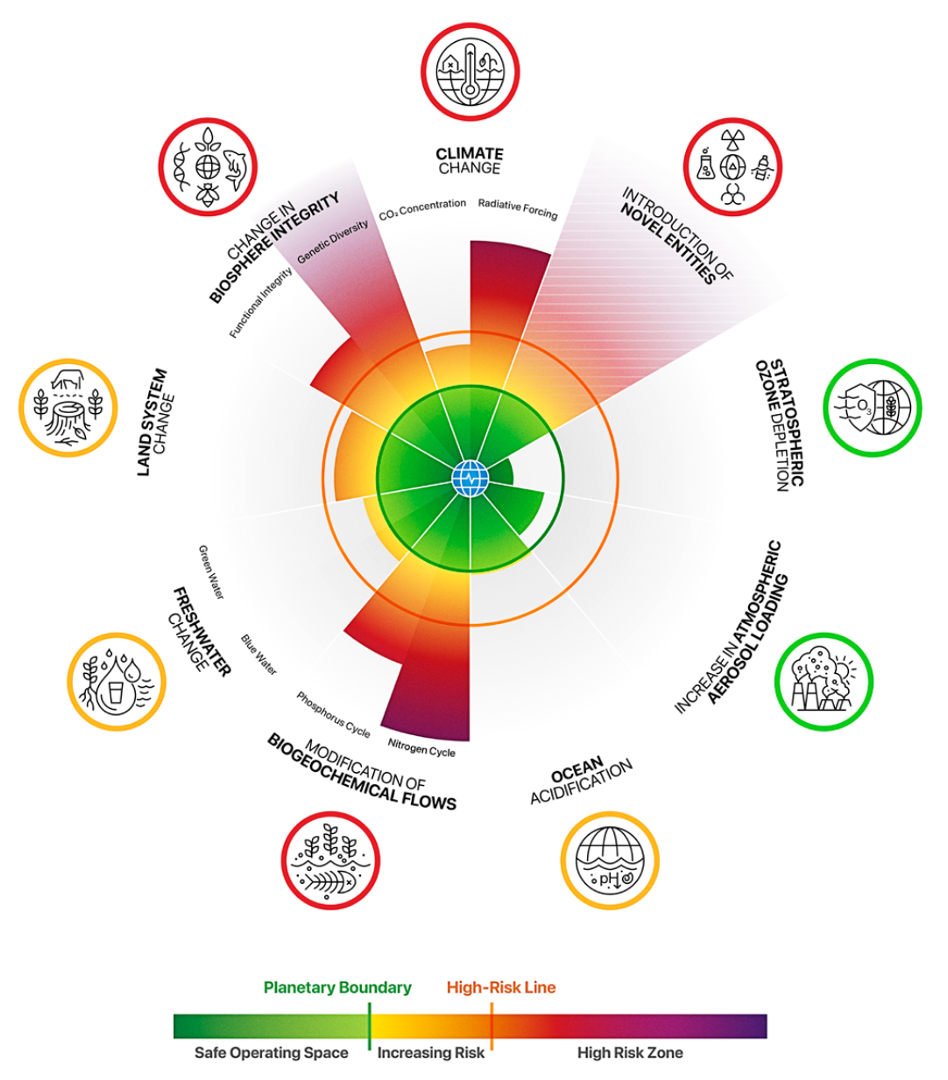
Canada must commit to becoming a 'One Planet' Canada as soon as possible — that is, a country with an ecological footprint per capita equivalent to its fair share of the one planet's worth of biocapacity available, operating within the safe operating space defined by the planetary boundaries framework.
Canada's approach to sustainable development must recognize that economic activity exists within, and is dependent upon, ecological and social systems. The Government must commit to a wellbeing economy that prioritizes the equitable wellbeing and flourishing of people and planet ahead of traditional measures of economic stability and growth.
In particular, the Government must:
Also in the spirit of truth and reconciliation with Indigenous Peoples, Canada's approach to sustainable development must centre and uphold the Sovereignty and Inherent Rights of Indigenous Peoples, including as articulated in the United Nations Declaration of the Rights of Indigenous Peoples and set out the in the Calls to Action of the Truth and Reconciliation Commission of Canada.
The Federal Sustainable Development Strategy must address the disproportionate impacts on racialized and otherwise marginalized communities and workers. These groups bear the brunt of the social, ecological and economic harms caused by development but do not share equitably in the benefits. Addressing these impacts requires meaningful action to eliminate the structural and systemic mechanism that create and perpetuate environmental racism. It also necessitates remedies – including remediation, restoration and reparations - for the harms caused to ensure environmental justice for impacted frontline communities and workers.
The FSDS should be much more strongly aligned with Canada's Quality of Life Framework, which explicitly aims to move 'beyond GDP' in pursuing social and ecological wellbeing. The Quality of Life framework should guide all policies, across all sectors, in line with the FSDS.
Following the inspiring Welsh model, Canada should adopt a Wellbeing of Future Generations Act and appoint a Future Generations Commissioner for Canada, whose role is to be the guardian of future generations.
To ensure public support and buy-in for a revised Sustainable Development Strategy, the Government of Canada must ensure an ongoing process of nation-wide, community-based conversations about the situation we face and the future we want for our descendants.
Parliament and the government must establish the necessary structures and mechanisms to enable the transition to a Wellbeing economy and society, including a Parliamentary Standing Committee on Canada as a Wellbeing Society, and a Wellbeing Society Cabinet Committee (with the option of the existing Cabinet Committee on Quality of Life and Wellbeing being empowered and resourced to effectively achieve this mandate).
These governance mechanisms — including a Parliamentary Standing Committee on Canada as a Wellbeing Society and a Wellbeing Society Cabinet Committee — would ensure the structural capacity for long-term, cross-government transition planning.
The Quality of Life Framework, and in particular the principles of sustainability, equity and the wellbeing of people and the Earth's natural systems, guide all public policy and projects, including the budget.
We respectfully urge the Government of Canada to take these 12 recommendations seriously and fundamentally revise the draft Federal Sustainable Development Strategy so that it becomes a true instrument of sustainable development — one fit for the realities and urgencies of the 21st century.
The signatories below — from across Canadian civil society, academia, health, business, and community — stand united in this call.
1 Resource and extractive sectors such as agriculture, fossil fuel extraction, forestry, fisheries, and mining; related pollutant production and use — chemicals for manufacturing, pesticides and other sectors listed here; as well as infrastructure development such as buildings construction, urban development, transportation and related systems.
2 Comprehensive wealth is "a country's produced, natural, human, financial and social capital" (IISD, 2018).
3 "Inclusive wealth measures the assets that underpin a nation's income flows and human well-being: natural, human and produced capital." (UNEP, 2023)